Why are group classes a good idea? And not just for children

Paula
—11 Aug 2026
When someone writes to us, question number one is usually the same: "Do you have one-to-one classes?".
I get it. One-to-one seems safer — nobody's watching, nobody's judging, all the teacher's attention is just for me. And there are situations where it really does make sense.
But after years of teaching, I feel that a group does something one-to-one simply can't. And I mean both seven-year-olds and adults.
Here are three reasons why at Languart we choose small groups.
1. Someone always feels like it
In one-to-one classes it's easier to let yourself off the hook. "It's not my day." "Can we do something more relaxed today?".
Of course! That's fine too — everyone has a bad week, and nobody has to show up to class fully battle-ready.
But sometimes, with those very words, we drain our own energy. We agree with ourselves on less and… we get less.
In group classes all it takes is one person who wants to get going (and I don't mean the teacher, they always have to want to :D), and the rest pick it up. Someone cracks a joke, someone gets excited about a scene, someone answers before they've had time to think — and suddenly the whole group is somewhere else than five minutes earlier.
It works the other way too: on a bad day you can hide behind the others for a while, and that's completely okay. The group will carry you along.
2. No fear later on
This is one of those reasons that rarely comes up when signing a child up for English, but that I see here every day.
We get 30-year-olds who usually want to start with one-to-one classes because they're afraid of being in a group — of being judged, of making a fool of themselves, of being the worst.
And I understand them very well. It's just that this fear was built up in them at some point and then stayed for years — in work meetings, job interviews, trips abroad.
Working in a small group from an early age gets you used to the fact that everyone makes mistakes, everyone asks questions because they don't know something, and everyone is scared sometimes. It's not shameful, it's a normal part of learning.
A child who has been speaking English in front of three other people since the age of seven, with nobody laughing at them (or rather, with everyone laughing along with them, because they said something funny and that's great), simply doesn't build up that fear.
3. It's more fun!
Funny stories from real life and made-up ones. Funny mistakes and slips of the tongue. Dialogues, scenes in the queue at the butcher's — there's always loads of laughter.
You can't do that on your own. Improv, a scene, an argument about who gets to be the shop assistant and who plays the grumpy lady at the end of the queue — for that you need another person.
And we believe that we learn best and remember the most through laughter. Not because it sounds nice in a school description, but because that's simply how it is — a word that made the whole group cry with laughter stays in your head for years.
"But in a group I'll speak less"
That's the most common worry, and with big groups — completely justified.
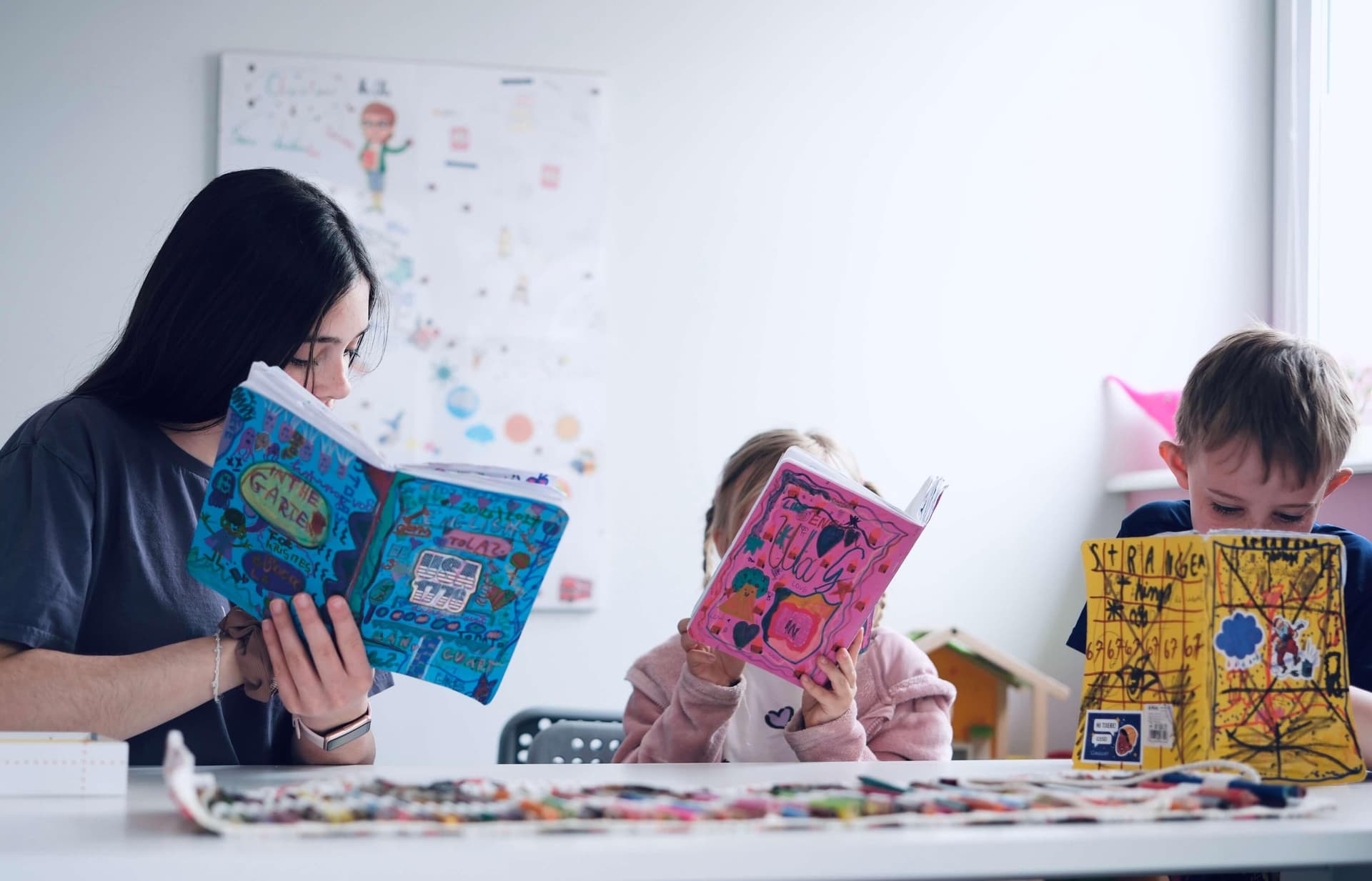
That's why our groups have 3–4 people. With a number like that, everyone speaks, everyone has their role in the scene and there's nowhere to hide for more than a minute. It's still a group, but small enough that nobody is just in the background.
So who are one-to-one classes for?
I don't want to pretend they never make sense. They do — when preparing for a specific exam in a short time, at a very unusual level, or when your schedule really doesn't allow for anything else.
But if you're torn between "one-to-one or group" and none of those reasons apply to you — give a group a try. It's worth it :)