Everyday language in an (un)usual way - what's behind the Languart slogan?

Paula
—12 May 2026
I spent a long time thinking about a slogan that could capture the atmosphere of our school. At first it was "The art of learning a language" — because of the school's name, a combination of the words language and art. But over the years we've been running, I came to feel that the word "art" rather distances us from everyday life, while language is, after all, something we use every day. I wanted our school to be seen as something closer to people — because art seems to be further away rather than closer.
I wondered what the goal of our teaching is, and I realised that our main mission is to teach people to speak a foreign language day to day, in ordinary, real-life situations. Not when, once every 5 years, we need to take part in a debate on whether aliens exist, but precisely when someone starts chatting to us in the lift, asks for directions, when the flight attendant asks what we'd like to drink, or when we're talking to foreigners who ask us what bigos is and want us to explain it.
That explains the first part of the slogan — "everyday language". That's exactly what we teach: not fancy words, but what every one of us needs.
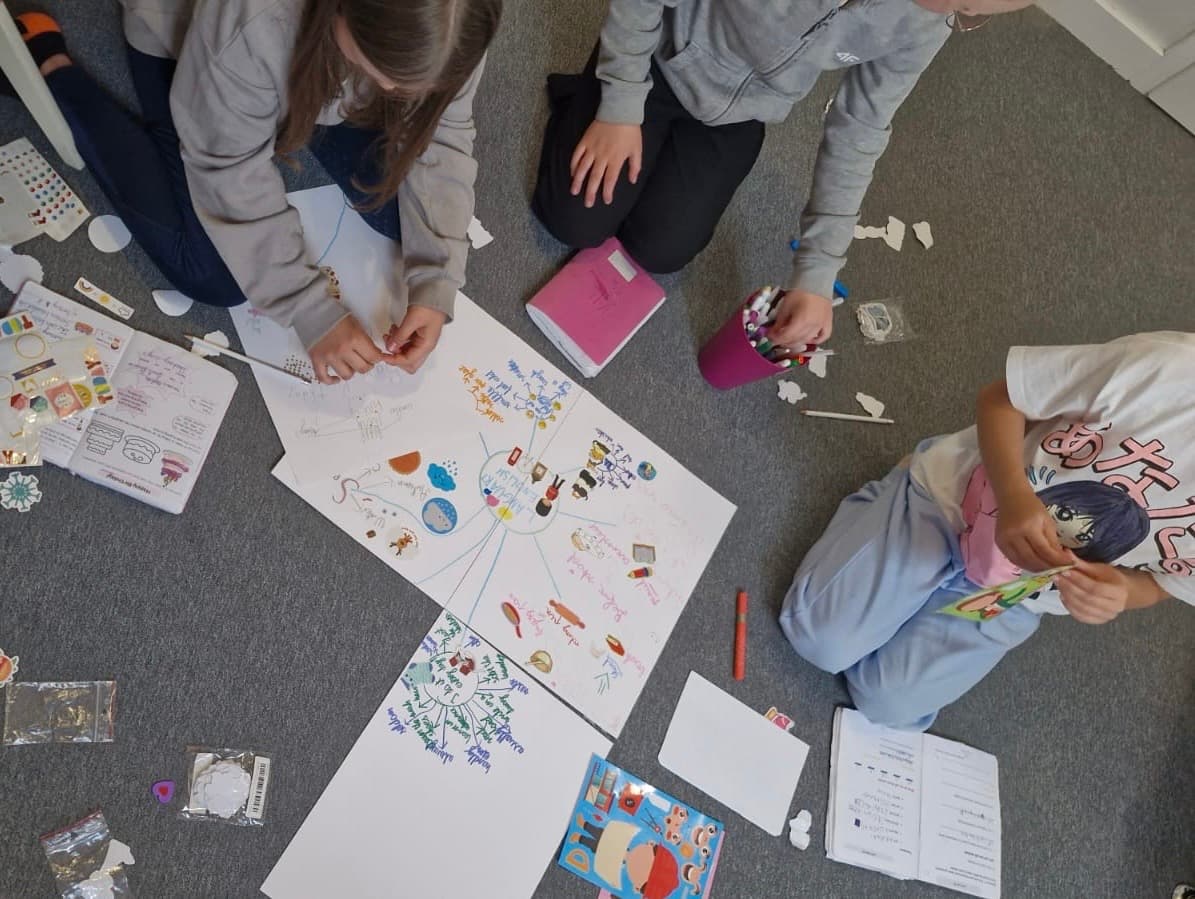
The second part, on the other hand, is meant to show how we do it. I hid two words in it: "everyday" — because our guiding idea is learning to speak, to hold a conversation, to express yourself freely — and at the same time "unusual", because we use drama and theatre improv to do it, tools you won't find at every language school. So the whole slogan, ordinary as it is, is also in a way extraordinary.
In our classes we talk about parcel lockers, learn small talk about health — "Chyba coś mnie bierze" = I think I'm coming down with something — as well as everyday expressions like "przesuń się troszeczkę, proszę" = Scoot over a bit, please. Simple, everyday things and expressions — and yet we so rarely learn them in an everyday way. Why not change that? :)